
.bw-guide{–navy:#082b4c;–teal:#087f7b;–gold:#f4b942;–ink:#12243a;–muted:#53657a;–line:#d9e3ec;–soft:#f3f8f8;color:var(–ink);font:17px/1.72 system-ui,-apple-system,BlinkMacSystemFont,”Segoe UI”,sans-serif;max-width:1180px;margin:0 auto}.bw-guide *{box-sizing:border-box}.bw-guide h1,.bw-guide h2,.bw-guide h3{color:var(–navy);font-family:Georgia,”Times New Roman”,serif;line-height:1.15}.bw-guide h1{font-size:clamp(2.3rem,5vw,4.4rem);margin:.1em 0 .28em}.bw-guide h2{font-size:clamp(1.75rem,3vw,2.55rem);margin:1.5em 0 .45em}.bw-guide h3{font-size:1.28rem;margin:.2em 0 .35em}.bw-guide a{color:#056d70}.bw-guide .hero{display:grid;grid-template-columns:minmax(0,1.55fr) minmax(290px,.75fr);gap:32px;padding:46px;border:1px solid var(–line);border-radius:24px;background:linear-gradient(135deg,#f8fbfb,#edf6f5)}.bw-guide .eyebrow{text-transform:uppercase;letter-spacing:.13em;font-weight:800;font-size:.77rem;color:var(–teal)}.bw-guide .lede{font-size:1.18rem;max-width:760px}.bw-guide .chips{display:flex;flex-wrap:wrap;gap:8px;margin-top:22px}.bw-guide .chips span{background:white;border:1px solid #bfd3dc;border-radius:999px;padding:6px 11px;font-size:.84rem;font-weight:700}.bw-guide .hero-card{background:var(–navy);color:white;border-radius:19px;padding:26px;box-shadow:0 18px 36px rgba(8,43,76,.18)}.bw-guide .hero-card h2{color:white;font-size:1.65rem;margin:.25em 0}.bw-guide .hero-card a{color:white}.bw-guide .button{display:block;text-align:center;text-decoration:none;font-weight:800;border-radius:10px;padding:13px 16px;margin:14px 0}.bw-guide .button.gold{background:var(–gold);color:#08233f}.bw-guide .body{max-width:850px;margin:0 auto;padding:10px 20px 70px}.bw-guide .quick,.bw-guide .prompt,.bw-guide .worked,.bw-guide .voice,.bw-guide .note{border-radius:16px;padding:24px;margin:25px 0}.bw-guide .quick{background:#e7f5f1;border-left:5px solid var(–teal)}.bw-guide .prompt{background:#f8fafc;border:1px solid var(–line)}.bw-guide .label{font-size:.75rem;text-transform:uppercase;letter-spacing:.1em;font-weight:900;color:var(–teal)}.bw-guide .worked{background:white;border:1px solid var(–line);box-shadow:0 10px 25px rgba(12,40,60,.06)}.bw-guide .weak,.bw-guide .better{padding:15px;border-radius:10px;margin:10px 0}.bw-guide .weak{background:#fff2f0;border:1px solid #efc8c1}.bw-guide .better{background:#eaf7f3;border:1px solid #b7ddd4}.bw-guide .method{counter-reset:step;display:grid;gap:13px}.bw-guide .step{counter-increment:step;border:1px solid var(–line);border-radius:14px;padding:19px 19px 19px 66px;position:relative}.bw-guide .step:before{content:counter(step,decimal-leading-zero);position:absolute;left:18px;top:18px;color:var(–teal);font-weight:900}.bw-guide table{width:100%;border-collapse:collapse;margin:20px 0}.bw-guide th,.bw-guide td{text-align:left;vertical-align:top;padding:13px;border-bottom:1px solid var(–line)}.bw-guide th{background:var(–navy);color:white}.bw-guide .inline-cta{display:grid;grid-template-columns:1fr auto;gap:20px;align-items:center;background:#0e5c70;color:white;border-radius:18px;padding:25px;margin:34px 0}.bw-guide .inline-cta h3{color:white}.bw-guide .inline-cta .button{min-width:190px}.bw-guide .voice{background:#f7f2ff;border-left:5px solid #6a4a91}.bw-guide blockquote{font:1.24rem/1.5 Georgia,serif;margin:0 0 10px}.bw-guide .checklist{list-style:none;padding:0}.bw-guide .checklist li{padding:9px 0 9px 34px;border-bottom:1px solid var(–line);position:relative}.bw-guide .checklist li:before{content:”✓”;position:absolute;left:5px;color:var(–teal);font-weight:900}.bw-guide details{border:1px solid var(–line);border-radius:12px;padding:14px 16px;margin:10px 0}.bw-guide summary{cursor:pointer;font-weight:800;color:var(–navy)}.bw-guide .sources li{margin:9px 0}.bw-guide .fine{font-size:.86rem;color:var(–muted)}
@media(max-width:780px){.bw-guide .hero{grid-template-columns:1fr;padding:26px}.bw-guide .inline-cta{grid-template-columns:1fr}.bw-guide .body{padding-inline:8px}.bw-guide th,.bw-guide td{display:block}.bw-guide th{display:none}.bw-guide td{padding:9px 11px}}
Compare and Contrast Essay Structure With a Worked Outline
Students searching for comparison essay structure usually need more than a definition. The guide below turns the task into decisions, demonstrates the method, and explains how to check the result.
What this assignment is really asking you to do
A label such as narrative, descriptive, expository, or analytical changes the intellectual job of the paper. A reliable draft starts by identifying that job, then choosing a structure that makes the required thinking visible.
For this guide, the central job is to compare subjects through shared criteria and produce a meaningful conclusion from the comparison. Keep that sentence beside the rubric while drafting. It is a more reliable control than a memorized paragraph template.
Read the prompt as a set of decisions
Treat the rubric as part of the question. A criterion that asks for explanation, interpretation, or justification requires more than a correct fact or quotation.
Compare two approaches to remote employee supervision.
Keep the task narrow enough to finish. When the prompt permits choice, prefer evidence you can verify and an angle you can explain fully within the assigned space.
| Key element | How it functions in this task |
|---|---|
| basis of comparison | basis of comparison is the first element to define from the prompt. Write what it means in this writing task before you decide how much space it deserves. |
| shared criteria | shared criteria controls an important choice in the solution. Mark the exact evidence, value, passage, or instruction that will support it. |
| point-by-point | point-by-point should be visible in the submitted work, not left for the reader to infer. Plan where it appears and what proves it. |
| block method | block method gives you a quality-control question. Ask whether the current draft performs this job accurately and completely. |
| significance | significance connects the method to the requested result. Use it when you explain why the answer follows from the work shown. |
A worked example: weak response and stronger reasoning
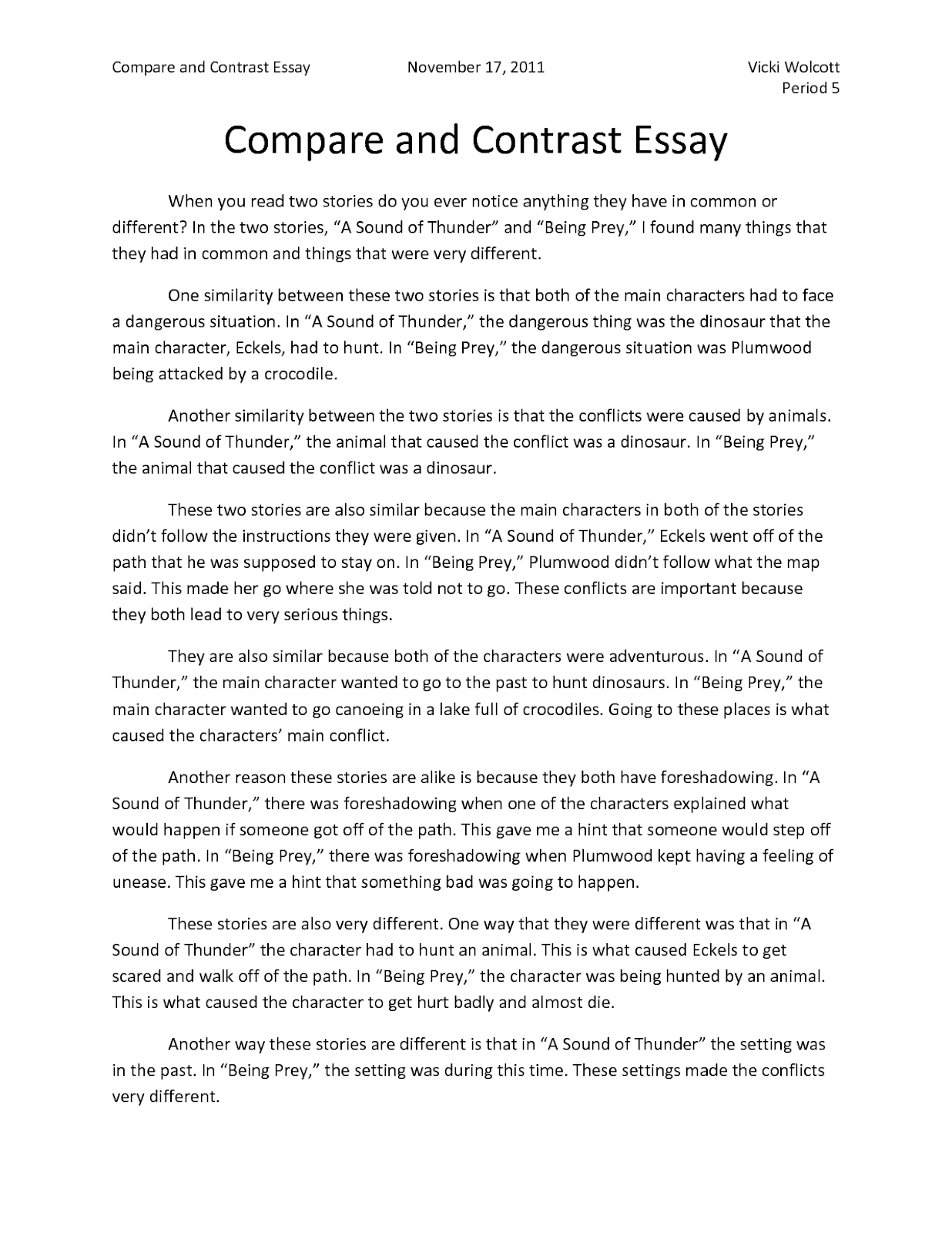
A grader can see the subject here, but not the method. The answer needs a rule, criterion, source relationship, or operation that can be checked.
The improved answer supplies the missing middle. It identifies basis of comparison, uses shared criteria, and reaches a conclusion that is no broader than the support.
Compare the two versions by asking what operation was added: definition, calculation, interpretation, qualification, or source connection. Make the same type of repair with your own evidence.
A six-step method you can use
Clarify basis of comparison in the prompt
Read the prompt aloud and mark every verb. Restate the assignment in plain language, with special attention to compare subjects through shared criteria and produce a meaningful conclusion from the comparison.
Decide how shared criteria will function
State your provisional answer in ordinary language. Then test whether shared criteria makes it more precise or exposes a missing condition.
Connect point-by-point to the requested result
Ask “what permits this next step?” after every major sentence or calculation. Record the role of point-by-point when it provides that permission.
Build the work around block method
Reserve a place for the strongest support under each reason. Beside block method, write the inference you expect the reader to accept.
Test the limits of significance
Change one assumption and see whether the conclusion survives. Explain what significance does under that altered condition.
Audit the complete response
Finish with a three-column audit: requirement, location, and repair. Give basis of comparison its own row rather than assuming it is covered.
How to use evidence without losing the point
Quality matters more than accumulation. Select evidence you can explain accurately instead of stacking references that never enter the reasoning.
Separate note-taking from source copying. Summarize the relevant point in your own words and record the location needed to verify it later.
Open the cited guidance when a rule affects your work. Secondary summaries can omit the condition that determines whether the rule applies.
What a real student difficulty reveals
“I always struggle getting started with my essays.”
Posted by a student asking for help with an argumentative thesis on Reddit.
Real student experience reminds us that knowing a rule and applying it are different tasks. Practice the application on a small example before returning to the full draft.
Student comments illustrate common experiences. They are not scholarly evidence, and the official prompt, course materials, and instructor feedback remain controlling.
Common problems and direct repairs
| Problem | Repair |
|---|---|
| 1. Starting with the format instead of the task | Return to the instruction verbs and write a checklist. Organize only after you know what the reader must be able to see. |
| 2. Naming basis of comparison without using it | Use basis of comparison as a test: identify the exact sentence or step where it affects the answer. |
| 3. Jumping from shared criteria to the final answer | Trace the answer backward until it meets shared criteria. Repair the first unsupported link you encounter. |
| 4. Treating point-by-point as decoration | Place point-by-point immediately beside the point it supports, then explain the relationship in your own words. |
| 5. Ignoring block method during revision | Ask another reader to explain the role of block method. Revise where their explanation differs from your intention. |
A practical revision sequence
Begin revision at the prompt, not the first sentence. Match each requirement to a paragraph, equation, table, or citation in the current work.
Test the method with a fresh example or counterexample. Once the result survives, complete the format and proofreading checks required by the class.
- The response defines or demonstrates basis of comparison at the point where the reader needs it.
- shared criteria has a clear role and is not included as detached background.
- The connection between point-by-point and the central answer is explained.
- block method is supported by the appropriate example, source, rule, or working step.
- The conclusion respects the limits revealed by significance.
- The final presentation follows the current prompt, rubric, and required style.
Sources and further reading
- Harvard College Writing Center, Strategies for Essay Writing
- Harvard College Writing Center, Transitions
- Harvard College Writing Center, Conclusions
Course requirements change. Check the current assignment, style manual, program page, and instructor directions before submitting.
Frequently asked questions
What should I do first for comparison essay structure?
Copy the prompt into your notes and separate its verbs, evidence rules, and submission limits. Then restate the task in one sentence you can check while drafting.
How can I use the example on this page?
Ask what changed between the two versions, then make that type of change in your own work using the course prompt.
How do I know whether my answer is detailed enough?
Detail is sufficient when the method is reproducible and the conclusion is supported, not when the document merely reaches a target length.
Can Bright Writers review my essaytype assignment?
Yes. Support can focus on confusing concepts, method checks, rubric alignment, draft feedback, citations, or editing, depending on what you have already done.
Get help with this assignment
If you are unsure how to apply the method to your own prompt, send the instructions, rubric, and the work you have completed. Bright Writers can help with concept explanation, planning, rubric review, draft feedback, editing, and revision guidance.
You retain authorship, responsibility, and control of every submission.
{“@context”:”https://schema.org”,”@graph”:[{“@type”:”BlogPosting”,”@id”:”https://thebrightwriters.net/how-to-write-a-compare-and-contrast-essay/#article”,”headline”:”Compare and Contrast Essay Structure With a Worked Outline”,”description”:”A practical, source-backed guide to compare subjects through shared criteria and produce a meaningful conclusion from the comparison.”,”datePublished”:”2020-03-25T07:35:16+00:00″,”dateModified”:”2026-09-15T10:30:00+03:00″,”mainEntityOfPage”:{“@id”:”https://thebrightwriters.net/how-to-write-a-compare-and-contrast-essay/”},”author”:{“@type”:”Organization”,”name”:”Bright Writers Editorial Team”,”url”:”https://thebrightwriters.net/about-us/”},”publisher”:{“@type”:”Organization”,”@id”:”https://thebrightwriters.net/#organization”,”name”:”Bright Writers”,”url”:”https://thebrightwriters.net/”},”about”:[“basis of comparison”,”shared criteria”,”point-by-point”,”block method”,”significance”],”keywords”:[“comparison essay structure”,”basis of comparison”,”shared criteria”,”point-by-point”,”block method”,”significance”],”citation”:[“https://writingcenter.fas.harvard.edu/pages/strategies-essay-writing”,”https://writingcenter.fas.harvard.edu/transitions”,”https://writingcenter.fas.harvard.edu/conclusions”]},{“@type”:”BreadcrumbList”,”@id”:”https://thebrightwriters.net/how-to-write-a-compare-and-contrast-essay/#breadcrumb”,”itemListElement”:[{“@type”:”ListItem”,”position”:1,”name”:”Home”,”item”:”https://thebrightwriters.net/”},{“@type”:”ListItem”,”position”:2,”name”:”Academic Writing Guides”,”item”:”https://thebrightwriters.net/blog/”},{“@type”:”ListItem”,”position”:3,”name”:”Compare and Contrast Essay Structure With a Worked Outline”,”item”:”https://thebrightwriters.net/how-to-write-a-compare-and-contrast-essay/”}]},{“@type”:”FAQPage”,”@id”:”https://thebrightwriters.net/how-to-write-a-compare-and-contrast-essay/#faq”,”mainEntity”:[{“@type”:”Question”,”name”:”What should I do first for comparison essay structure?”,”acceptedAnswer”:{“@type”:”Answer”,”text”:”Copy the prompt into your notes and separate its verbs, evidence rules, and submission limits. Then restate the task in one sentence you can check while drafting.”}},{“@type”:”Question”,”name”:”How can I use the example on this page?”,”acceptedAnswer”:{“@type”:”Answer”,”text”:”Ask what changed between the two versions, then make that type of change in your own work using the course prompt.”}},{“@type”:”Question”,”name”:”How do I know whether my answer is detailed enough?”,”acceptedAnswer”:{“@type”:”Answer”,”text”:”Detail is sufficient when the method is reproducible and the conclusion is supported, not when the document merely reaches a target length.”}},{“@type”:”Question”,”name”:”Can Bright Writers review my essaytype assignment?”,”acceptedAnswer”:{“@type”:”Answer”,”text”:”Yes. Support can focus on confusing concepts, method checks, rubric alignment, draft feedback, citations, or editing, depending on what you have already done.”}}]}]}